blueprint2cad
Blueprint2CAD: Benchmarking Foundation Models on Engineering Drawing-to-CAD Render Correspondence
1Novineer, Florida, USA
2Instituto Tecnológico de Costa Rica, San José, Costa Rica
3University of Würzburg, Würzburg, Germany






Abstract
Engineering drawings specify mechanical parts through orthographic projections. Recognizing which part a drawing depicts underlies part search, design reuse, and digitization, yet no public benchmark measures whether vision models can do it. We introduce Blueprint2CAD, a benchmark for drawing-to-render correspondence: given an orthographic line drawing and a shaded render, usually from another viewpoint, decide whether they show the same part. Its data layer, BlueCAD-30K, applies an open drafting pipeline to 29,925 Zero-to-CAD models, adding view-aligned renders, clean and dimensioned drawings from six viewpoints, and surface-type metadata. Frozen encoders retrieve the matching part from a 10,000-model gallery with up to 65% Recall@1 when viewpoints are known but 43% when they are not, and the four encoders we test lie within six points of each other: viewpoint, not backbone, is the bottleneck. Six zero-shot vision-language models reach only 0.52–0.67 verification accuracy, with model-specific Yes/No biases that chain-of-thought shifts but does not remove; a quick LoRA fine-tuning on in-domain pairs improves verification accuracy by a few points but sharpens these biases and leaves the viewpoint failure intact.
Summary
- BlueCAD-30K: 29,925 STEP models from Zero-to-CAD, each with six shaded renders and six clean and six dimensioned hidden-line drawings under a shared camera rig, plus B-rep surface-type metadata and model-level train / val / test splits. Hosted on Hugging Face.
- Frozen encoders (DINOv3, SigLIP 2, RADIO, TIPSv2) retrieve drawings ↔ renders over a 10,000-model gallery. With known viewpoints the best reaches 65% R@1; without them 43%. A non-learned silhouette descriptor already reaches 49% aligned R@1.
- Six zero-shot VLMs (Claude Sonnet 5, Gemini 3.6 Flash, GPT-5.6 Luna, Mistral Small 3.2 24B, InternVL3.5 14B, Qwen3-VL 8B) score 0.52–0.67 on binary verification; each carries its own Yes/No prior, and top/bottom renders defeat every model.
- LoRA on Qwen3-VL 8B lifts verification from 0.670 to 0.685 but drops retrieval to chance and sharpens the No bias.
Tasks
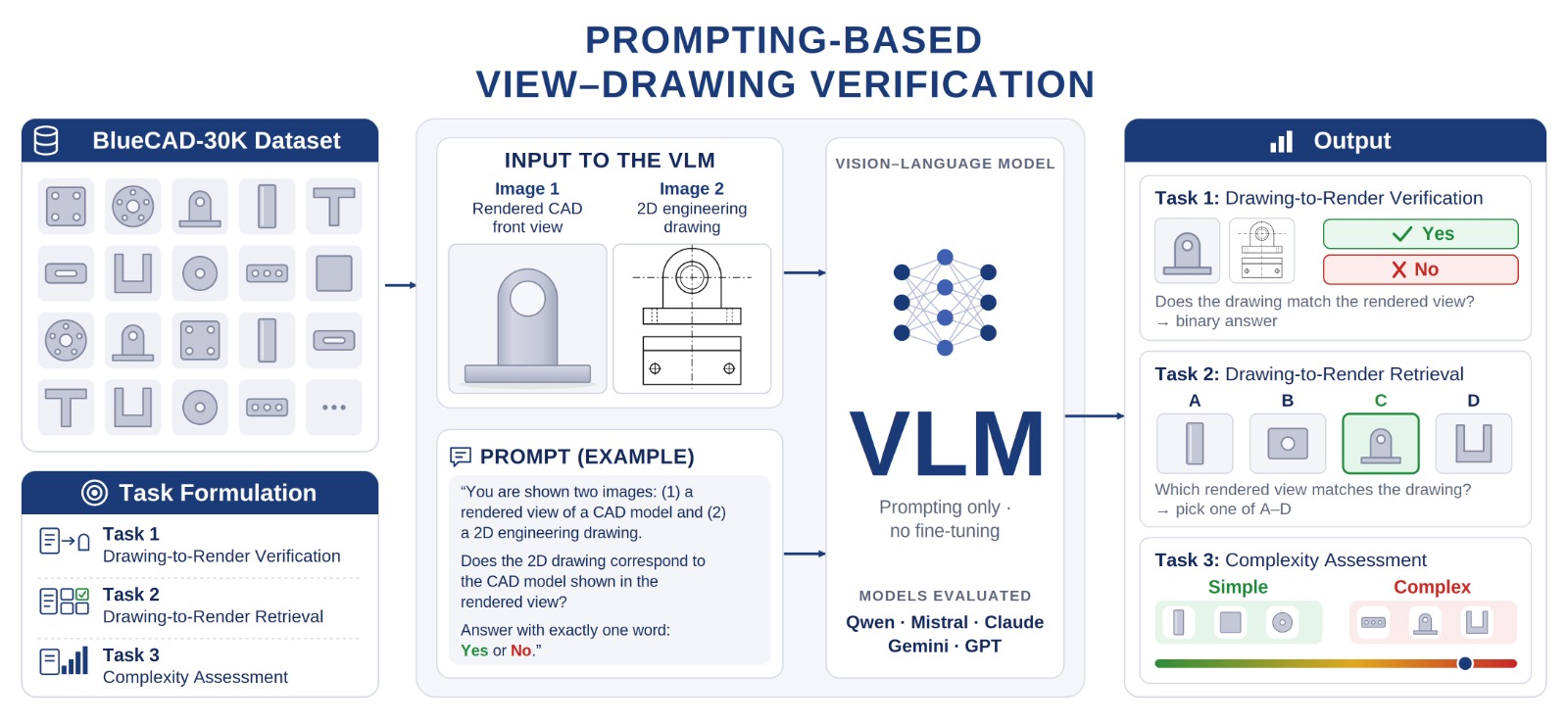
All inputs are pairs of 2D images: a line drawing and a render. Nothing is claimed about recovering 3D geometry.
| Task | Input | Question | Chance |
|---|---|---|---|
| Retrieval (VFMs) | 1 drawing, 10,000 renders | Which gallery model matches? Reported as R@k, MRR, median rank, view-agnostic and view-aligned | 0.01% R@1 |
| Task 1: Verification | front drawing + render from any view | Same part? Yes / No (also with dimensioned drawings and chain-of-thought) |
0.50 |
| Task 2: Retrieval | right-view drawing + 4 right-view renders | Which render matches? A–D |
0.25 |
| Task 3: Complexity probe | six renders | Simple or Complex, no criterion given; scored against surface-type class |
0.50 |
Task 1 prompt:
You are shown a rendered view of a CAD model and a 2D engineering drawing.
The two images may show the part from different viewpoints.
Do they depict the same part? Answer with exactly one word: Yes or No.
Results
Frozen-backbone retrieval (R@1 %, drawing → render, 10,000-model gallery). Max / Mean assume unknown viewpoints; Al-max / Al-mean use known viewpoints.
| Backbone | Max | Mean | Al-max | Al-mean | MRR (Al-mean) |
|---|---|---|---|---|---|
| Silhouette | 7.85 | 20.16 | 10.06 | 48.54 | 0.555 |
| DINOv3 | 29.10 | 43.11 | 34.67 | 65.14 | 0.728 |
| TIPSv2 | 34.39 | 34.65 | 38.58 | 64.65 | 0.724 |
| SigLIP2 | 29.52 | 38.07 | 33.54 | 64.15 | 0.714 |
| RADIO | 27.46 | 36.54 | 30.98 | 59.51 | 0.675 |
Fusing views one at a time (DINOv3, Al-mean) goes from 14.9 R@1 with front alone to 65.6 with five views; top and bottom are the strongest single views. Adding dimension annotations costs at most 7 R@1 points.
VLM benchmark (accuracy, n = 1000; bold = best zero-shot).
| Model | Task 1 | Task 1 + dim | Task 2 | Task 3 |
|---|---|---|---|---|
| Claude Sonnet 5 | 0.635 | 0.590 | 0.374 | 0.520 |
| Gemini 3.6 Flash | 0.654 | 0.670 | 0.690 | 0.562 |
| GPT-5.6 Luna | 0.670 | 0.654 | 0.637 | 0.676 |
| Mistral-S 3.2 24B | 0.534 | 0.524 | 0.274 | 0.521 |
| InternVL3.5 14B | 0.624 | 0.637 | 0.266 | 0.506 |
| Qwen3-VL 8B | 0.669 | 0.655 | 0.317 | 0.512 |
| Qwen3-VL 8B (LoRA) | 0.685 | 0.699 | 0.241 | 0.553 |
No pair among the four leading models differs significantly on Task 1. Claude and GPT-5.6 lean towards Yes, Gemini, Mistral and InternVL towards No; chain-of-thought moves each bias without correcting it (best CoT result +0.7 points). On Task 3 every model except GPT-5.6 answers Simple on 88–98% of a balanced set.
Dataset
Every model goes through the same pipeline (vfms/src/):
- Filtering and complexity (
geometry/): a B-rep parser drops non-watertight or degenerate models and scores each one from seven normalized signals (freeform-face ratio, face count, non-planar ratio, surface-type entropy, inner loops, curved-edge ratio, sphericity). The 500 lowest and 500 highest scoring models form the VLM evaluation set (simple = prismatic, complex = freeform). - Drawings (
rendering/): six canonical orthographic projections (front, back, left, right, top, bottom) with OpenCascade’s exact hidden-line removal, stored as layered DXF and rasterized to 1024 × 1024 PNG. The dimensioned variant adds overall width and height. - Renders: Blender, same six camera axes, 1024 × 1024 with transparent background, so drawing and render correspond by construction.
Splits (by model identifier), the 1,000-model VLM evaluation set and the 10,000-model retrieval gallery are released with the data on Hugging Face.
BlueCAD30K/data/
  drawings/<id>/normal/<id>_{front,...,bottom}.png
  drawings/<id>/dim/<id>_{front,...,bottom}_dim.png
  renders/<id>/000.png ... 005.png  (+ transforms.json)
Repository
vfms/src/
  geometry/     STEP complexity scoring and simple/complex subset selection
  rendering/    HLR drawings (DXF), PNG rasterization, auto-dimensioning
  extractor/    multi-view feature extraction (CLIP, DINOv1/2/3, RADIO, SigLIP2,
                I-JEPA, SAM, SAM3, Depth Anything, TIPSv2)
  analysis/     retrieval experiments 1–3 and the silhouette baseline
vlms/src/
  benchmark/    Tasks 1–3 (prompts, item files, metrics, CLI, viewpoint breakdown)
  finetune/qwen LoRA training, evaluation and attribution for Qwen3-VL
Usage
Retrieval with a frozen encoder. Extract one descriptor per view for each modality, then run the experiments.
cd vfms/src/extractor
python multiview_extract.py --dataset BlueCAD30K/data/drawings --output features/dinov3/drawings \
    --model-type dino-v3 --model-name facebook/dinov3-vitb16-pretrain-lvd1689m --num-views 6
python multiview_extract.py --dataset BlueCAD30K/data/renders  --output features/dinov3/renders \
    --model-type dino-v3 --model-name facebook/dinov3-vitb16-pretrain-lvd1689m --num-views 6

cd ../analysis
python experiment_1.py --feat features/dinov3 --ids ids.txt --key cls --name dinov3 --center  # Tab. 1
python experiment_2.py --feat features/dinov3 --ids ids.txt --key cls --name dinov3 --center  # view fusion
python experiment_3.py --feat features/dinov3 --ids ids.txt --key cls --name dinov3 --center  # dim ablation
python silhouette_baseline.py ...                                                             # non-learned baseline
VLM benchmark. The item files used in the paper are in vlms/src/benchmark/items/. Set OPENAI_API_KEY, GEMINI_API_KEY or ANTHROPIC_API_KEY, or point --base-url at any OpenAI-compatible endpoint; --provider local runs a Hugging Face checkpoint, optionally with a LoRA adapter.
cd vlms/src/benchmark
python run.py run --items-file items/task1_items.json --provider openai --model gpt-5.6-luna
python run.py run --items-file items/task1_items.json --provider gemini --model gemini-3.6-flash --cot
python run.py run --items-file items/task2_items.json --provider local --model Qwen/Qwen3-VL-8B-Instruct \
    --adapter runs/qwen3vl8b_lora_bluecad30k
Each run writes one JSON to results/ with raw responses, parsed predictions, and metrics overall, by complexity class and by negative tier.
Fine-tuning. Paths and the prompt are in vlms/src/finetune/qwen/config_qwen.py.
cd vlms/src/finetune/qwen
python train_qwen.py                          # rank-16 LoRA on language model + vision encoder
python train_qwen.py --load-4bit --grad-ckpt  # QLoRA for a ~24 GB GPU
python eval_qwen.py --data data/test.jsonl --adapter runs/qwen3vl8b_lora_bluecad30k --out results/ft_8b.csv
eval_qwen.py reads the next-token log-probabilities of Yes / No in a single forward pass and reports forced-choice accuracy, ROC-AUC, best-threshold accuracy, ECE and d′, with breakdowns by negative type and render viewpoint.
Limitations
- Drawings are clean orthographic projections from one procedural generator: no section views, GD&T, title blocks or scan artifacts.
- View-aligned scoring uses oracle viewpoint labels and is a diagnostic; the view-agnostic setting is the deployable one.
- Models are evaluated frozen or zero-shot, with a single small LoRA variant.
- Simple / complex follow B-rep surface type, not expert judgement of complexity.
Citation
@inproceedings{valverde2027blueprint2cad,
  title     = {Blueprint2CAD: Benchmarking Foundation Models on Engineering Drawing-to-CAD Render Correspondence},
  author    = {Valverde, Alexander and Xie-Li, Danny and Wang, Zhichao and Conde, Marcos V.},
  booktitle = {Proceedings of the IEEE/CVF Winter Conference on Applications of Computer Vision (WACV) Workshops},
  year      = {2027}
}
Acknowledgements
Built on Zero-to-CAD, OpenCascade (via pythonocc), ezdxf, Blender, DINOv3, SigLIP 2, RADIO, TIPSv2, Qwen3-VL and LoRA. Data is released under CC BY 4.0 and code under Apache 2.0.